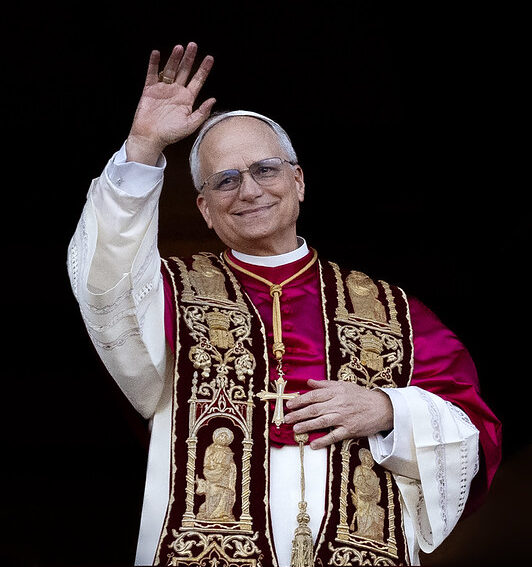
When “Cardinal” Robert Prevost emerged on May 8, 2025 as “Pope” Leo XIV, many Catholics expected either a quiet administrator or a modest corrective to the turbulence of the Francis years. Some members of “Trad Inc.” even thought he might become the savior of Tradition.
But when in his first speech on the balcony of St. Peter’s Basilica he spoke of wanting to be “a synodal church,” we should have known better.
The Dispatch
Leo’s first year confirmed something far darker: continuity with the heretic Francis and his campaign to wipe the Catholic Church off the face of the earth. Not only that, day after day we received irrefutable evidence that the “Bergoglian” revolution was not only not ending but intensifying in far more destructive ways than over the previous 12 years.
Even though Vatican sources and promoters of the Synodal sect reported on his statements and acts as a faithful applications of recent magisterium, it is clear to those with eyes to see that the same words and actions are damning proof of further doctrinal erosion, liturgical dilution, and practical indifferentism. To catalogue the atrocities of the man known as Leo XIV in the space is impossible.
The writing was on the wall almost immediately after his election. On May 19, 2025, in one of his first major addresses to representatives of false religions, Leo thanked them for their presence and prayers and insisted that Catholics must not create “opposition between one church and another.” He called for dialogue and bridge-building, and he invoked Nostra Aetate while speaking warmly to Jewish and Muslim leaders. He would continue to repeat the familiar Vatican II formulation that Muslims “worship God, who is one… merciful and almighty” on numerous occasions during the first year of his tenure. For faithful Catholics, this was an unmistakable declaration that ecumenism and interreligious dialogue would remain central.
Read more: The Synodal Church’s teaching on proselytism contradicts the Gospel
His doctrinal language followed the same line. Leo strongly condemned the death penalty, calling it “inadmissible because it is an attack on the inviolability and dignity of the person,” echoing the revised Catechism and Francis’s teaching. At the same time, he reaffirmed that “every human life is sacred, from conception to natural death,” thereby explicitly linking opposition to abortion, euthanasia, and capital punishment under a single framework of human dignity. The Vatican framed this as consistent Catholic teaching; however, it was clearly part of a campaign to galvanize a modernist redefinition of morality, particularly because Catholic tradition formerly accepted the legitimacy of capital punishment under certain conditions.
Legitimate controversy once again erupted in the aftermath of Leo’s February 2026 Olympic letter, Life in Abundance. There he cited Christ’s words from John 10:10, speaking of “life in abundance” as “a life filled with meaning, a life in which physicality and inner life find harmony.” This made Prevost either the most theologically impoverished “pope” in history or revealed a further attempt to brazenly corrupt Christ’s teaching by reducing the supernatural promise of grace and eternal life to psychological wellness and bodily flourishing.
His social teaching followed the same dismal pastoral trajectory. In June 2025, addressing the United Nations Food and Agriculture Organization, Prevost remarked that in the multiplication of the loaves, “the real miracle … was to show that the key to overcoming hunger lies more in sharing than in selfishly hoarding.” He would later repeat a version of this blasphemous demythologizing denial of Christ’s miraculous power, in which he turned the Gospel into a lesson in redistribution. It was becoming clearer on a week-to-week, day-to-day, and sometimes hour-to-hour basis that Leo XIV was more interested in humanitarianism than supernatural salvation.
This pastoral emphasis culminated in October 2025 with Dilexi Te, an exhortation centered on love for the poor. The document was received positively in mainstream modernist Catholic media as a “treasury of Catholic social doctrine,” but its tone was an embarrassment compared to the great pre-conciliar papal documents. It rarely cited older pre-conciliar popes, which was further proof that Leo’s theological imagination is shaped almost entirely by the Second Vatican Council and Francis rather than by the hard doctrinal language of a Trent or a St. Pius X that the Church and modern society needed.
Liturgically, Leo has offered little hope to those expecting restoration. His ceremonies remained recognizably Francis-era: vernacular liturgy, modern ceremonial forms, modest symbolism, and no visible push to restore the Traditional Latin Mass. On the contrary, he continues to look the other way as disgusting prelates like “Bishop” Martin of Charlotte, North Carolina persecute Catholics seeking the Latin Mass and reverence. Prevost might chant the Our Father in Latin well, but it is all clearly a distracting cosmetic while the post-conciliar liturgical structure remains untouched. He has shown no major effort to rehabilitate the Traditional Latin rite beyond some toothless remarks to the French Bishops, and he seems to condone the destruction of the traditional liturgy through silent non-confrontation as though he does not want to get his hands dirty.
If his approach to doctrine and liturgy frustrated his critics, Leo’s ecumenism has been even more enraging. Inter-religious outreach has been one of the defining marks of his first year. In October 2025, in a prayer intention video, he addressed Christ with the words: “You, who in diversity are one and look lovingly at every person…” and urged religions to act as bridges. Worse, during a recitation of the Creed with Orthodox clergy, he not only left out the filioque, but later implied it was an outdated doctrinal difference that everyone needed to “leave behind.”
Suspicions that Prevost only had a One World Religion agenda on his mind further intensified during his April 2026 visit to the Great Mosque of Algiers. There, Leo praised the mosque as “a divine, sacred space where many come to find the presence of God.” He prayed that the peace and justice of the Kingdom of God might be present there as well. This statement was nothing but practical apostasy: the “Roman Pontiff” praising a non-Christian house of worship in terms traditionally reserved for consecrated Catholic space. Lest we forget that under his watch, Muslim prayer mats were introduced in the Vatican library.
Read more: Rome betrays Christ for Muhammad and Buddha in latest acts of treason
Most recently, his ecumenical posture toward Protestants produced more scandal. Leo formally greeted the newly installed Anglican “Archbishop” of Canterbury, Sarah Mullally, addressing her as “Your Grace” and offering prayerful greetings for her leadership. With this gesture he was legitimizing a transgender heretical cosplayer pretending to be a man pretending to be a bishop, all the while secretly giving his filthy effeminate henchman “Cardinal” Victor Fernandez the go-ahead to prepare a declaration of schism against the Society of Saint Pius X. This was just another instance in the past year of the man pretending to be the Vicar of Christ communing with every degenerate heretic and obstinate false religious representative, while dismissing and outlawing those who seek to practice true Catholicism. These repeated gestures also confirmed that institutional ecumenism has displaced the missionary duty to convert.
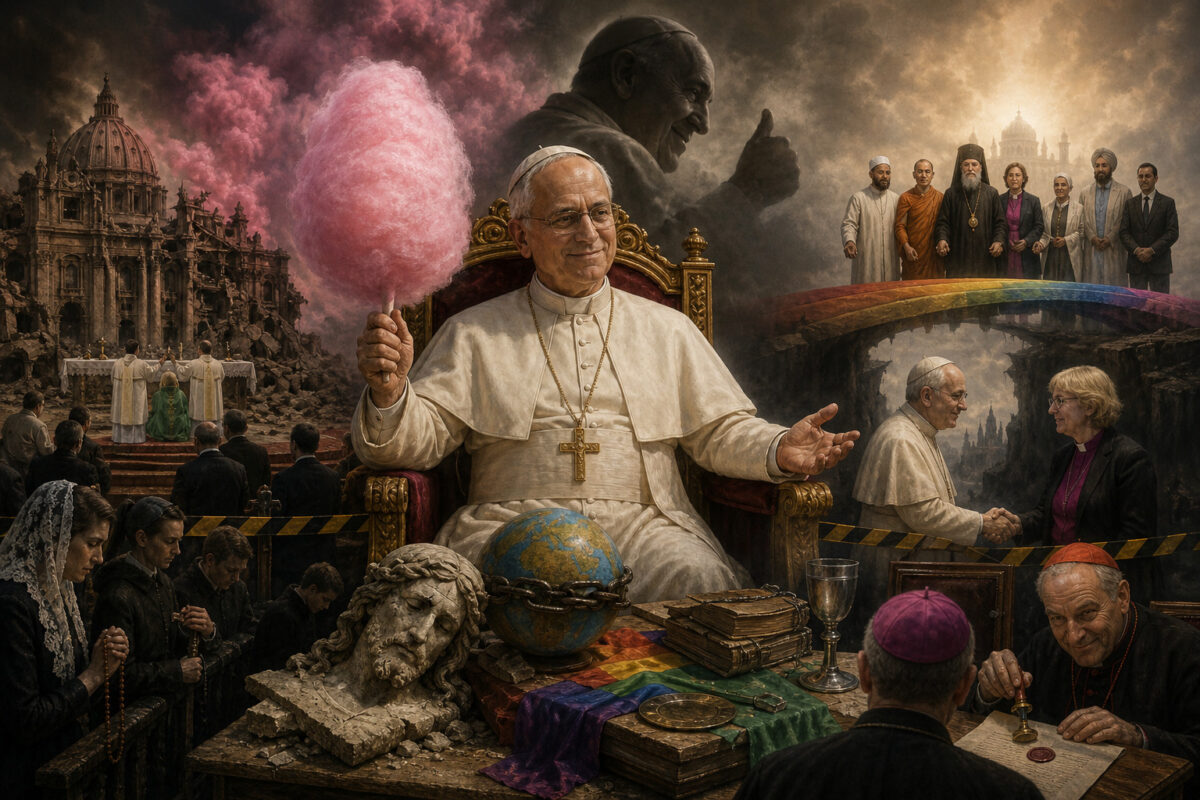
These are just a few of the highlights (lowlights?) of the anti-Catholic scandals Prevost has inflicted on the faithful in the name of Catholicism in a single year. There were, of course, far too many to mention here, as I already said. The frequency with which the “pope” from Chicago and his posse of heretics are deconstructing Catholicism is enough to give one vertigo. And from the desecrated rubble, right before our eyes, they are building their new idol in rebellion against God: The Synodal Church.
Regardless of your own personal position on the status of the occupation of the papal seat, it is fair to observe that the sheer scale of deception, cowardice, and ambiguity that characterized the first 365 days of Prevost’s “papacy” places him on the wrong side of salvation history. The only thing the Augustinian has proved is that the conciliar crisis is permanent. His polished manner, occasional use of Latin, and personal austerity do little to offset his fundamental doctrinal betrayal.
For his sake, and for the millions he has been leading astray with a whiff of incense and a dash of Latin, I pray that he repents before it is too late.