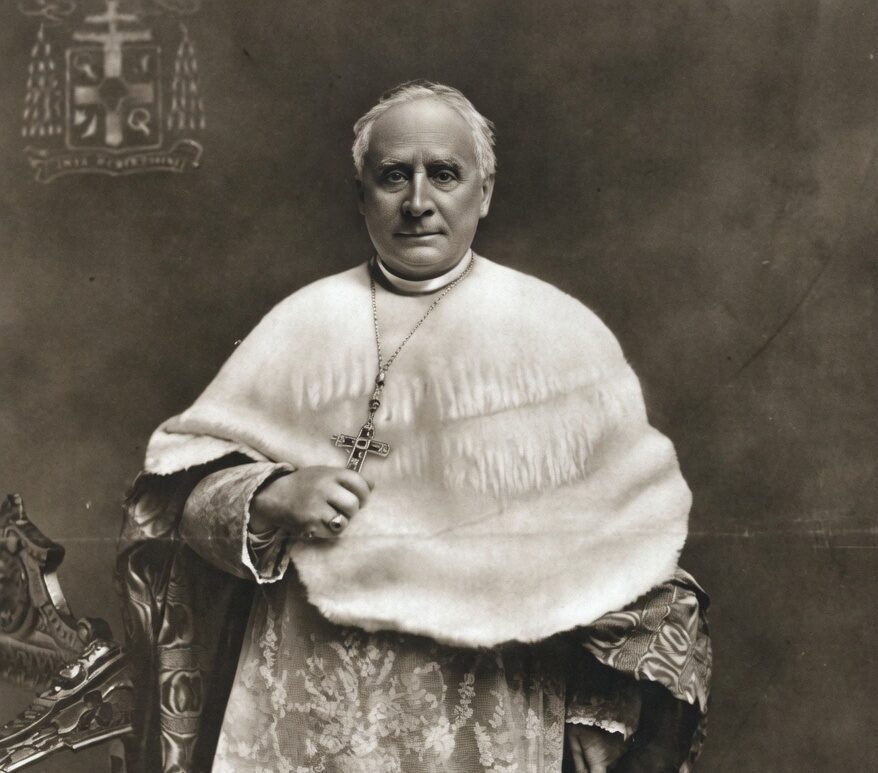
In his 1899 apostolic letter Testem benevolentiae nostrae, Pope Leo XIII denounced the constellation of errors that came to known as “Americanism.” The Americanist affair involved various clergy not only in the United States but also in France, where Fr. Charles Maignen vigorously opposed its most vociferous proponents.
James Cardinal Gibbons, the Archbishop of Baltimore from 1877 until 1921, was the most prominent figure in the US at the time. An ally of Americanists such as Archbishop John Ireland of Minnesota, Gibbons attended the ecumenical World Parliament of Religions meeting in Chicago in 1893. News of the scandal quickly reached the Vatican, prompting Leo to ban Catholics from attending future gatherings.
The Dispatch
One clergyman close to Gibbons was his long-time friend and protégé, John Cardinal Farley, Archbishop of New York from 1902 to 1918. Like Ireland, Farley held views at odds with Church teaching.
Farley promotes Modernism in New York
In 1907, Archbishop Farley invited professor Charles Augustus Briggs of Union Theological Seminary in Manhattan to lecture his students at Dunwoodie Seminary in Yonkers. Briggs spoke about the need for what he called the unification of the Catholic Church with Protestant churches. 1
Briggs’s views on the Bible were so radical that he was “excommunicated” from the Presbyterian Church in 1893. Among his many heterodox views was that Moses was not the author of the Pentateuch. One year prior to Briggs’ appearance at Dunwoodie, the Pontifical Biblical Commission denounced that opinion, a development that Briggs decried as a “barrier to the reunion of Christendom.” St. Pius X mandated submission to the Commission’s condemnation in Praestantia Scripturae in 1907.
In 1905, Farley established the New York Review to indoctrinate his seminarians with Modernist ideas. During its brief existence, the Review featured articles written by George Tyrrell (1861-1909), Ernesto Buonaiuti (1881-1946), and Joseph Turmel (1859-1943), all of whom were eventually excommunicated for Modernism.
Another project Farley relied on was the Catholic Encyclopedia, which was started in 1907. While the original Encyclopedia was a good resource on many topics, it contained subversive errors of liberal exegesis and Biblical Modernism.
For instance, in the 1909 edition, an article titled “Biblical Exegesis” appeals to St. Jerome in order to claim that that the historical portions of Scripture do not relate factual truth, but only what was then commonly believed. 2 This abuse of St. Jerome was explicitly condemned by Pope Benedict XV in Spiritus Paraclitus in 1920. Unsurprisingly, Farley not only contributed to the Encyclopedia but gave it his imprimatur.
Farley’s rationale for supporting the Review and the Encyclopedia came from his Americanist mindset. This was apparent when he complained about what he called “the exaggerated restrictive policy of the ecclesiastical authorities, who, through their unreasonably stringent methods of censorship (the Index, for example), only succeed in stifling all initiative on the part of the ablest and best-disposed Catholic scholars.” 3
Leo rebuked this exact attitude in Testem benevolentiae when he wrote, “there is even a greater danger and a more manifest opposition to Catholic doctrine and discipline in that opinion of the lovers of novelty, according to which they hold such liberty should be allowed in the Church, that her supervision and watchfulness being in some sense lessened.”
Ever the pragmatist, Farley knew he would have to adapt in order to survive the pontificate of St. Pius X in the wake of Pascendi Dominici gregis. In 1908, he shut down the Review and distanced himself from the Catholic Encyclopedia. He also denounced one of his own priests whom he had formerly supported, Fr. Francis Duffy, as a Modernist. Duffy was an editor for the Review and a Professor at Dunwoodie. “Poor Fr. Tyrrell’s death…” Farley additionally remarked, “will show the need of such a change.” 4
Sadly, Farley’s attempt to rebrand himself worked, as he was named a cardinal by St. Pius X himself in 1911.
While Farley and many other clergy “transitioned” in order to survive the purge taking place under St. Pius X, their liberal, Americanist, and Modernist ideas not only survived but spread underground until the Second Vatican Council.
- Shelley, “John Cardinal Farley and Modernism in New York”, in Church History, Vol. 61, No. 3 (Sept. 1992), p. 356 ↩︎
- Maas, Anthony. “Biblical Exegesis.” The Catholic Encyclopedia. Vol. 5. New York: Robert Appleton Company, 1909 ↩︎
- Shelley, “John Cardinal Farley and Modernism in New York”, in Church History, Vol. 61, No. 3 (Sept. 1992), p. 354 ↩︎
- Shelley, “John Cardinal Farley and Modernism in New York”, in Church History, Vol. 61, No. 3 (Sept. 1992), p. 359-360 ↩︎