
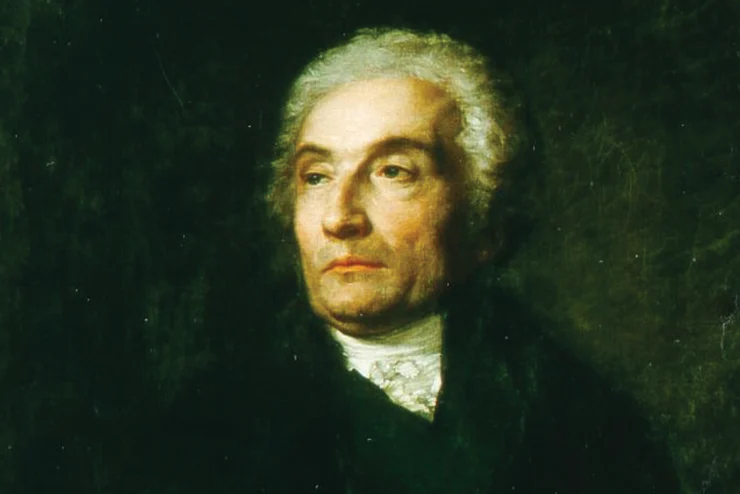
There is a thinker who predicted, with remarkable precision, that the French Revolution would collapse into tyranny, that the liberal political order built on its ruins would eventually hollow itself out, and that the West would one day find itself in a crisis it could not solve with the tools it had. He wrote all of this in the 1790s. His name is Joseph de Maistre, and almost nobody has heard of him.
That is worth pausing on. We live in a moment when serious people across the political spectrum sense that something fundamental has broken in Western civilization. Institutions that were supposed to guarantee freedom and stability are failing. Social trust is collapsing. The old political categories feel inadequate. In that context, the most penetrating diagnosis of how we got here was written over two hundred years ago by a Savoyard diplomat sitting in St. Petersburg. I find that either deeply ironic or deeply clarifying. I have come to think it is mostly the latter.
The Dispatch
Maistre was born in 1753 in Chambéry, the capital of Savoy, which was then part of the Kingdom of Sardinia. He trained as a lawyer, served as a senator, and was a devout Catholic at a time when that combination of faith and learning was perfectly natural rather than remarkable. When the Revolution reached Savoy in 1792, he was forced into exile, losing most of what he owned. He spent the next several decades as his country’s ambassador to the court of Tsar Alexander I in St. Petersburg, a posting that lasted fourteen years. He lived away from home, far from family, in the capital of a vast empire, writing books and letters that almost nobody read during his lifetime and that turned out to contain some of the most searching political thought of his era. He died in 1821, having watched Napoleon rise, tear Europe apart, and fall. He was not surprised by any of it.
What Maistre saw in the French Revolution that most of his contemporaries missed was not the violence, which was visible to everyone, but its cause. The standard view, then and now, is that the Revolution went wrong because of bad leaders, bad luck, or bad timing. Maistre rejected this entirely. He argued that the Revolution was not an accident. It was the inevitable consequence of an idea that had been gaining ground for generations: the Enlightenment conviction that human reason alone, without God or inherited tradition, could design a better society from first principles. Once a civilization accepts that premise, he believed, it has already set in motion a process that ends in chaos. You cannot build lasting order on abstract theories about human rights and popular sovereignty, which means the will of the majority, because human beings are not the rational, self-governing creatures that Enlightenment philosophy imagined. We are fallen. We are passionate, shortsighted, and capable of convincing ourselves that almost anything is justified.
This is why Maistre famously said that the Revolution devoured its own children. He did not mean this as a dark joke. He meant it as a logical consequence. The revolutionaries who proclaimed liberty and reason in 1789 were sending each other to the guillotine by 1793. For Maistre, this was not a tragic irony. It was exactly what should have been expected when a society decided to rebuild itself from scratch based on pure ideology rather than accumulated wisdom.
His critique of liberalism goes even deeper than his reading of the Revolution. Liberalism, broadly speaking, is the political philosophy built on individual rights, limited government, and the idea that legitimate authority comes from the consent of the governed. Maistre thought this was built on a fiction. Real authority, he argued, does not come from below. It does not come from the people or from a social contract, a theoretical agreement among individuals to form a society. It comes from something higher than human preference, something transcendent. When you sever that connection and try to ground political order entirely in human will, you have not liberated anyone. You have just made power available to whoever can most effectively claim to speak for the majority.
His thinking on law makes this concrete. Maistre was deeply skeptical of written constitutions, which were the great political fashion of his age. He argued that the best constitutions are not written at all. They are the accumulated product of centuries of custom, practice, and inherited wisdom, shaped by a people’s actual history and rooted in their moral and religious life. A group of men sitting in a room writing down principles of government is not creating order. It is performing order while the real foundations, which take generations to build, are ignored or actively dismantled. The best laws, he believed, are the ones no one remembers enacting because they grew naturally from the life of a people rather than being imposed on it by design.
In 2026, this argument has a different weight than it did in 1796. We have had two and a half centuries to watch the liberal democratic experiment play out. What we see is not reassuring. Constitutional democracies across the West are struggling to hold together. Procedural rules that were supposed to ensure fairness are being weaponized by whoever holds power. Shared moral foundations, the kind of common understanding about what is good and true that makes a society more than a collection of competing interests, have been eroding for decades. Maistre’s warning that you cannot sustain ordered liberty without something deeper than procedure has gone from being a reactionary provocation to sounding, increasingly, like an obvious observation.
I came to Maistre the way most people do, through his critics. He was described to me as a defender of tyranny, an enemy of progress, a dangerous romantic. When I finally read him, I found something different: a man who understood the fragility of civilization more clearly than almost anyone else of his time, and who had the intellectual courage to say unpopular things because he believed they were true. I have been thinking with him ever since.
For further reading enjoy the following primary works by Maistre:
- Considerations on France (1797) — The best place to start. Short, sharp, and written in the heat of the French Revolution. Maistre lays out his core argument that the Revolution was a providential punishment rather than a political accident. Accessible to any reader. Free at Internet Archive
- The St. Petersburg Dialogues (written 1809, published 1821) — Maistre’s masterpiece. A series of conversations on suffering, violence, providence, and the nature of political order. More philosophical than Considerations, but deeply rewarding. Free at Internet Archive
- Essay on the Generative Principle of Political Constitutions (1809) — A focused, relatively short work making the case against written constitutions. Directly relevant to contemporary debates about constitutional design and institutional legitimacy. Free at Internet Archive
- Against Rousseau (essays written in the 1790s, collected posthumously) — Maistre’s direct engagement with Jean-Jacques Rousseau, the philosopher whose ideas most directly shaped the Revolution. His most sustained critique of the social contract and popular sovereignty. Free at Internet Archive
- On the Pope (Du Pape, 1819) — Maistre’s argument for papal authority as the necessary foundation of European civilizational order. Essential for understanding his ecclesiology and his vision of the relationship between Church and political authority. Available through most university libraries.
- Letters on the Spanish Inquisition (published 1822) — A defense of the Inquisition that is more nuanced than it sounds and illuminates Maistre’s broader thinking on heresy, authority, and social order. Free at Internet Archive